Cohort 04, Master of Communication in Digital Media
Producer, Director, Writer, Editor, Researcher, Storyguide
Drew Keller on LinkedIn
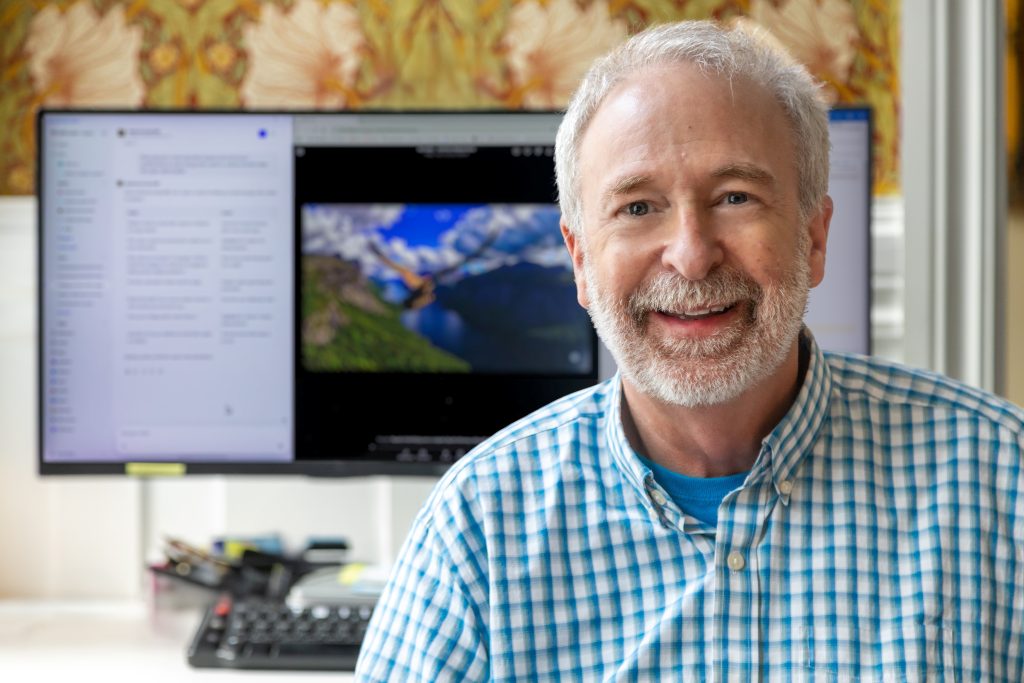
To start, if I approached you at a picnic and asked what you were up and enjoying these days, how would you answer?
I am fortunate to live in a place where “work/life balance” is practiced every day. I have immediate access to the sea and the mountains year-round, my office is three blocks from my house, and I have a rich community of friends. My work involves research at the University of Bergen and telling video stories. Two years ago, my wife and I purchased a 130-year-old villa and we’ve spent 14 months (and more money than I expected) restoring it.
The Summer 2026 alumni newsletter theme is exploring cities through the eyes of Comm Leaders and where they call home. Not all that long ago you and your family made a big move—from Washington to Norway—and Bergen is now home. Can you share with us a bit about your current hometown: how long it’s been home for you, and what you would describe as the personality of the city.
When we moved to Norway in 2021, the plan was a two-year adventure as I pursued graduate studies at the University of Bergen. It is safe to say that we thought the plan was temporary when we started. Five years later, Bergen is home.
Initially, I was struck by the obvious similarities between Bergen and Seattle. The history of both is rooted in maritime industries and the sea. Like Seattle, Bergen is surrounded by extraordinary natural beauty (the locals refer to this place as “The city between seven mountains” – although, curiously, there are nine of them and folks can never agree which are the actual seven.) The other obvious similarity is that both have a somewhat complicated relationship with rain. But there are differences.
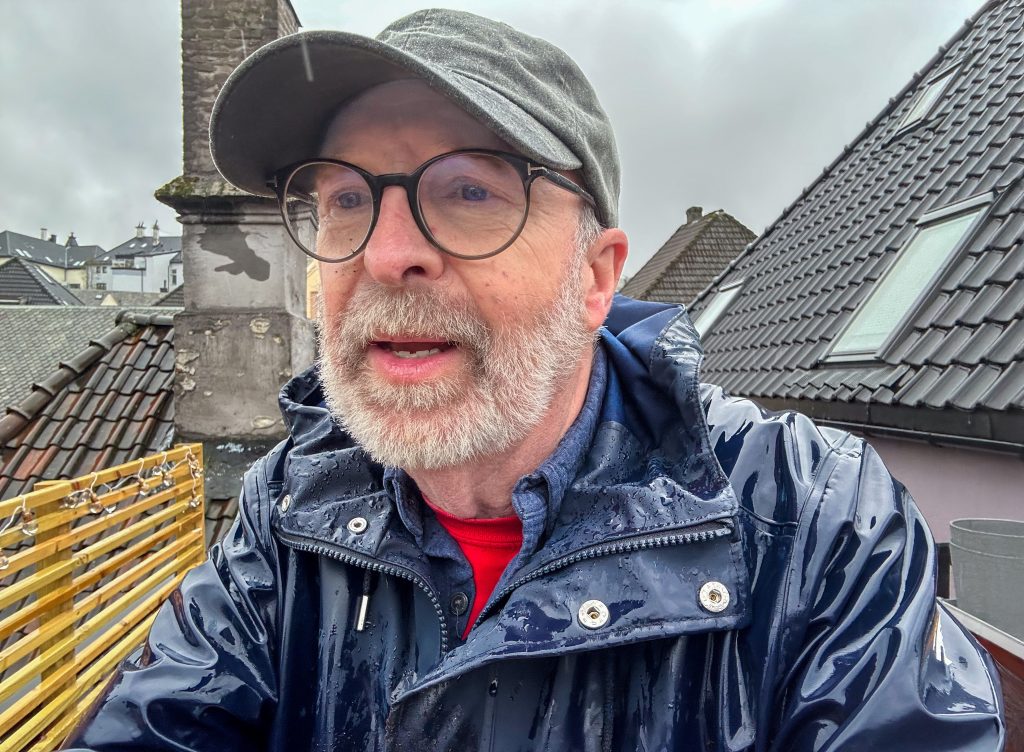
One of the things I have grown to appreciate is the human-scale of life here. I don’t own a car because I don’t need one. I walk everywhere – the market is around the corner, the center of town is 5 blocks away, and I can walk from my house to the mountains in 10 minutes. One significant difference is Bergen has an abundance of local stores – Amazon does not exist, no big-box mega stores, and very few shopping malls filled with franchises. This means we have a vital center of town where people live, work and shop. I am greeted by store owners, and I routinely bump into friends simply because we are all moving through the same relatively compact world. While Bergen is Norway’s second-largest city, I think of it more as a collection of neighborhoods nestled in a rather spectacular setting.
There is also a strong sense that access to the city—and to nature—is something shared. The mountains are part of everyday life. People disappear into them after work, on weekends, and whenever the weather offers even the faintest suggestion that it might cooperate. This is particularly true on one of the 5 days a year when the sun shines (did I mention this is Europe’s rainiest city?) There is even a tradition called “utepils” of grabbing a beer and sitting outside to catch the sun.
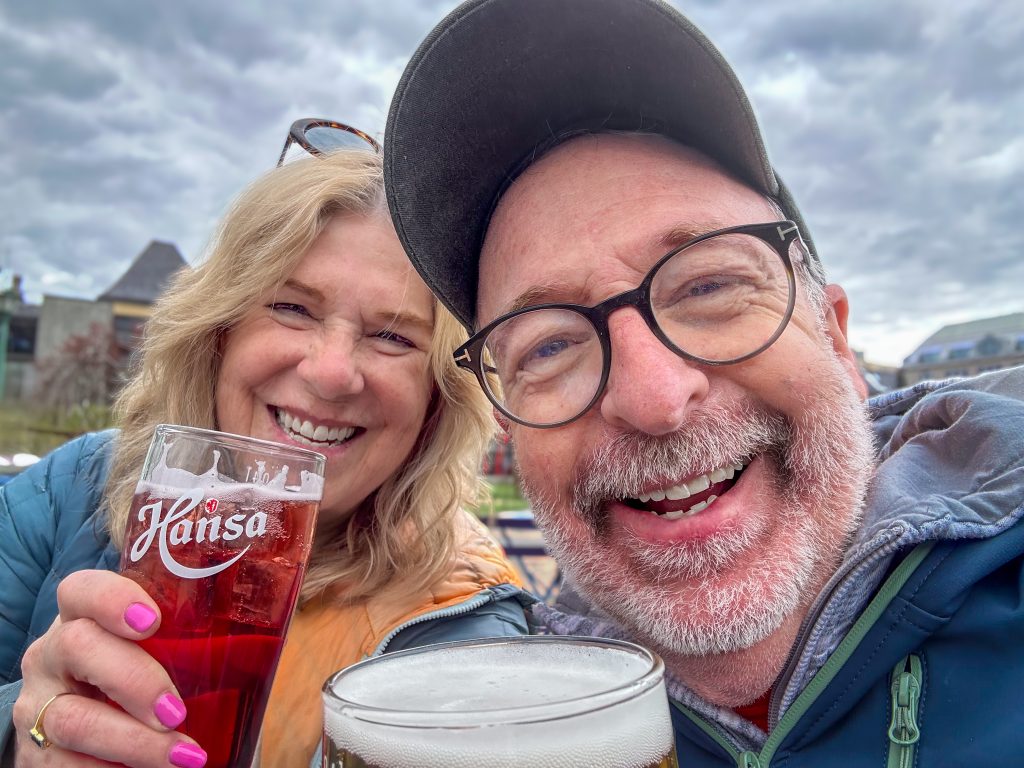
Bergen can be reserved at first. Norwegians are not generally inclined to talk with a stranger simply because you are in line together. It is easy to interpret this behavior as cold – think “Seattle Freeze” on steroids. Over time, you come to understand that this social reserve is really a manifestation of the culture’s respect for personal space. Making friends can be difficult. However, if you have a dog, everyone will talk to you. Over time I have found a remarkable sense of community, trust and social responsibility. Honestly, once Bergen accepts you, it has a way of quietly becoming difficult to leave.
Can you share a bit more about your work at StoryGuide and the University of Bergen, and if possible, showcase elements or your work that are particularly informed now by your Norwegian location?
From the very beginning of my career my work has lived somewhere between technology and storytelling.
I started StoryGuide 20 years ago as an umbrella for my independent work as a producer, director, writer, consultant and researcher. Intermingled with consulting and creating, I spent 17 years at Microsoft, with the last four years exploring the intersection of artificial intelligence, machine learning and video production. I left Microsoft in November 2025, but many of the questions I was working on there have followed me into my research at UiB.
We are all very familiar with the important discussions around generative AI and its capacity to create content. Much of that content is inherently forgettable for a whole host of reasons. My research over the last five years has been focused on a slightly different question: Can these technologies improve the creative process without generating stories that are a regression to the mean?
That distinction matters to me. The goal should not be to produce more content, faster. Although clearly that is where the market growth potential lies as demonstrated by the tidal wave of slop. Instead, I am interested in how emerging technologies can help filmmakers and storytellers spend less time on repetitive production tasks and more time making distinctive creative decisions.
That work now continues at the University of Bergen, where I am a researcher with the Extending Digital Narrative project at the Center for Digital Narrative. Our broader research explores how technologies including generative AI, virtual and augmented reality, and conversational systems are changing the forms stories can take. My own work remains particularly focused on production paths, generative media and retaining the human voice of the creators.
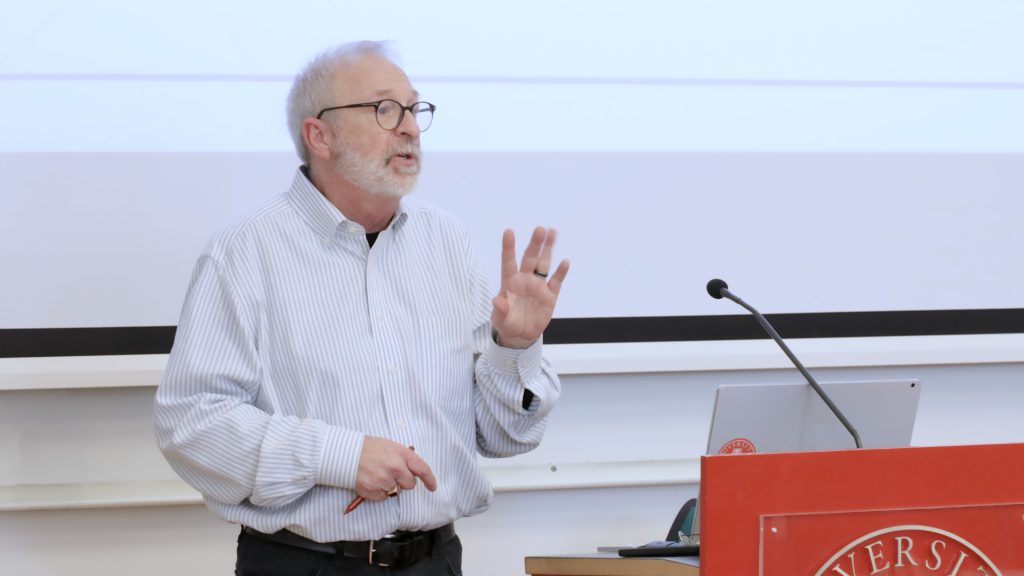
Living in Bergen has influenced that work in ways I did not necessarily anticipate. Norway has a very different cultural relationship with technology, work and public life than the United States, and being outside the American technology industry has given me some useful distance from assumptions I once took for granted.
At the same time, I have become increasingly interested in practice-based research—the notion that one way to understand a new storytelling technology is to actually make something with it, push against its limitations, break it occasionally, and then examine what happened. In my personal projects on YouTube, I leverage all sorts of AI tools. From matte generation to audio enhancements, from ideation tools to motion graphics.
That probably explains why I remain both a researcher and a filmmaker. Theory is fun, but does an idea actually work?
Bergen, and Norway more broadly, are enjoying a bit of an elevated profile given the national team’s current success in the World Cup. But what is something that you have to live in Bergen to understand that you can share with our readership?
When you travel to Norway the wonder of the fjords, the scale of the mountains, and the beauty of the vistas grab your attention. The more interesting differences reveal themselves slowly. I have come to realize that many of the qualities that make Norway appealing are often invisible to a visitor.
There is an extraordinary level of social trust here. Additionally, there is a deeply rooted belief that public spaces, the wilderness and many of society’s benefits belong to everyone. You see it in small things: how people use the mountains, how children move independently through the city, how little social status matters in everyday interactions.

Norway is no utopia, and Norwegians will be the first people to tell you that. But after living much of my life in the United States, I have become increasingly aware of how much energy Americans devote to negotiating hierarchy—who has more, who knows more, who is more important. Here, much of that volume gets turned down. I have been to countless social gatherings and not once has someone asked me, “What do you do for a living?” I believe the difference between the two cultures is in the States, meeting someone new is transactional. “Who are you, what do you do, is it is benefit to me?” Here it is more about, “How do you move through life?”
I also think Bergen teaches you something about the relationship between inconvenience and quality of life. The weather can be spectacularly uncooperative. Stores are closed on Sundays – a time when my American consumer instinct tells me they should obviously be open. The bureaucracy is incredibly opaque and things take time. There are rules. So many rules.
And yet, increasingly, I have discovered that many of the things I initially regarded as an inconvenience are part of what protects the quality of life I now enjoy.
The longer I live in Bergen, the less I think of it as a place I moved to. Now I simply think of it as home.
Finally, we always ask: what’s a favorite piece of content—anything goes!—you’ve been hooked on lately you think Comm Lead alumni might enjoy?
Curiously, over the past few years the time I spend as a content consumer has diminished significantly. My Disney+ subscription has lapsed, Netflix is largely ignored, and much of the razzle-dazzle has lost its appeal. Perhaps it reflects a larger cultural shift, perhaps it is just age, but I have been gravitating to the work of longer-form content creators, particularly on YouTube. Many of these storytellers are idiosyncratic with only rudimentary production skills. But the common threads are authenticity and an innate understanding of how to tell a story – beginning, middle and end. From Jacob Harrell’s efforts to restore a 500-year-old cottage in the Cotswolds, to Eirik’s efforts to start anew on “Norwegian Farm Life”, to Ahti’s furniture restoration on “AT Restoration.” They all tend to be somewhat self-effacing with a focus on solving life’s little challenges through wit and perseverance. Still… I worry this change is a reflection of getting older. I have to tell myself, “Hey, at least you’re not watching ‘Mattlock’ or ‘Murder She Wrote’.”

 University of Washington
 Department of Communication