by Sabrina Ho

The communications field has never been static. But as businesses adopt AI into their comms and marketing workflows to increase performance, being adaptable as a communication professional is more important than ever. We aren’t only considering creative execution in our plans. We must account for the future in an age of geopolitical instability and AI automation.
Companies are hiring with more caution and moving away from generalist media relations roles. For example, in 2025, gas and oil corporation Chevron shifted their focus to hiring seasoned media analysts with public and corporate sector experience who can navigate complex regulatory landscapes.
There’s increased demand for experts in data analytics, measurement, and executive/leadership communications. Applicants are facing higher expectations from recruiters to have a diverse skillset that can support multiple responsibilities, from content creation to digital literacy.
It sounds daunting. But these skills can be developed through hands-on experiences like internships and personal projects. And a strong professional network can help you identify which tools to actually prioritize.
Where the industry is headed
There has been a shift from execution-focused to strategy-focused roles as organizations prioritize their long-term vision. In today’s landscape, strategists don’t just manage routine deliverables—they ensure every decision stabilizes a company’s long-term success.
In McKinsey & Company’s “How Strategy Champions Win,” only 21% of surveyed executives reported that their companies possess high-quality strategy. When plotting the largest companies on the economic profit power curve, the top quintile captures nearly 90% of all economic surplus in their industries. Having a successful strategy moves a company up the curve. Strategists are now the bridge between vision and execution, as they align an organization’s capabilities with the demands of the market, making them critical assets in today’s competitive industries.
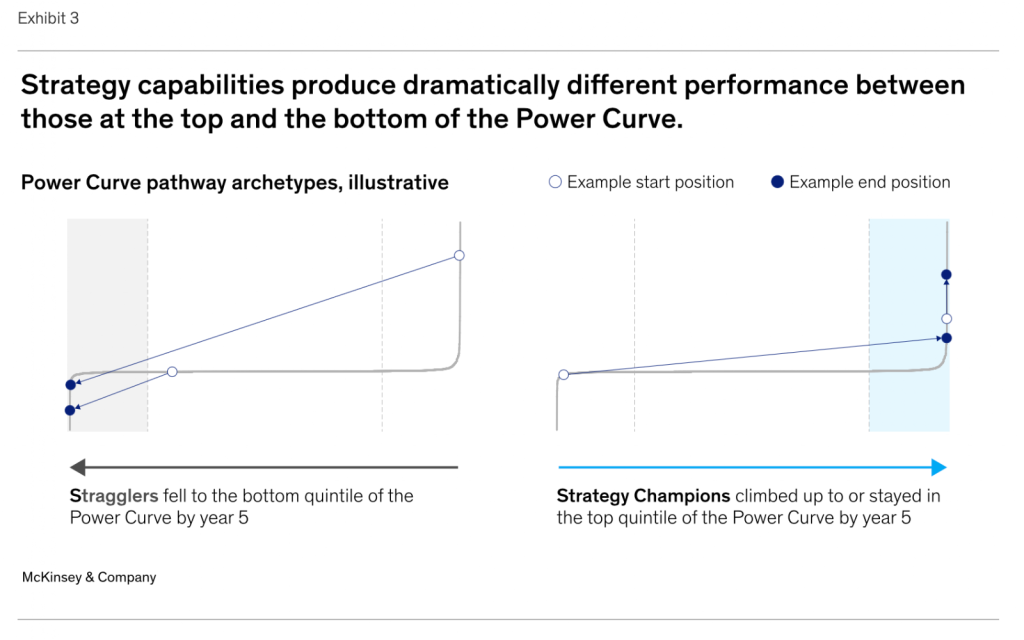
Figure: “Strategy Champions” and “Stragglers” from 400 companies on the Economic Profit Power Curve
Source: McKinsey & Company (2025), How Strategy Champions Win
The most successful businesses that stand the test of instability are the ones with forward-looking CEOs. The new generation of successful leaders is emerging from the cross-cultural complexities of today, while viewing ambiguity as opportunity. Also known as adaptive leadership, forward-looking leaders are focused on short-term delivery and long-term value creation.
In-demand roles
According to the U.S. Bureau of Labor Statistics, employment rates for marketing managers are projected to grow 6% from 2024 to 2034, faster than the average for all occupations. Marketing manager roles have an estimation of over 36,000 job listings every year.
While the hiring priorities will depend on the organization, there is an overall demand for talent that can not only execute campaigns, but strategically create them. Brands are prioritizing communication and marketing professionals who can translate high-level vision into data-driven storytelling, creating impactful strategy in a diversifying media landscape.
While digital marketing specialist, project manager, and social media specialist remain some of the most in-demand marketing roles overall, marketing and product manager roles are seeing the fastest growth in demand in 2026. All of these roles require skills in keeping up with audience research, technical tools, and multi-platform marketing. This reflects industry shifts toward an increased reliance on technology and a growing trend of leveraging social media marketing.
Skills that cut across roles
While the demands of communication roles differ, all successful communication professionals are strategic storytellers.
In a saturated market of content creation and automation, communication specialists really need to hone in on soft skills to ensure their brands stand out: strategic thinking, cross-functional communication, and the ability to translate complexity into clarity.
According to Forbes, “14 Critical Skills All Communications Professionals Should Be Cultivating,” communicators should be focusing more on interpersonal skills like inclusive communication, management, and listening.
COMMLD 540C/D: Public Speaking & Presenting with Impact explores why soft skills like public speaking are so powerful for resonating with audiences.
Yet, no matter what role you’re drawn to, whether it’s creating marketing campaigns or strategic communications plans, the most marketable skill to have is curiosity. Susan MacLaren, an Artist-in-Residence at Comm Lead who advises the student-run consultancy that helps pair students with organizations, explains why: curiosity drives proactivity.
“The thing with hard skills, those are going to be easy to pick up,” MacLaren said. “People want to know that you’re proactive, that you can take something and run with it without needing a lot of direction.”
In today’s competitive job market, it’s not enough to just list out skills and experiences on a resume—you need to be able to speak to real-world experiences that you can bring to the job from day one.
Every day, aspiring applicants like Comm Lead students are building their portfolio through their classes, internships, and volunteer activities.
Skill-Building at Comm Lead
There isn’t just a single communication style that fits all organization models, which is why communication professionals must identify the best leadership style that fits their team in order to deliver impactful storytelling to their audiences.
COMMLD 501: Leadership and Communities explores such leadership development through the lenses of storytelling and community by considering cultural context, communication styles, and how each person’s role plays into the larger customer-brand experience.
Building upon these foundational leadership skills, students are then equipped to lead communications in their departments and apply them to industry-specific challenges. For example, students interested in becoming product marketing managers have the challenge of promoting products that resonate with diverse audiences, but how is this achieved when factoring in changing trends and consumer culture?
COMMLD 520D: Product Marketing considers these challenges by analyzing hands-on real-world case studies, conducting research, and creating data-driven storytelling. By examining consumer insights and market trends, aspiring marketing managers are equipped with the necessary tools to lead successful team product launches.
There also can’t be a conversation around in-demand jobs today without understanding where AI falls into content creation. According to LinkedIn News, AI literacy is the top growing skill in media and communications. With a growing demand for AI literacy, AI content strategist roles have also been on the rise as brands are working on finding the balance between human-centric work and AI automation. When should you use AI for comms, and who should be empowered to use it?
COMMLD 581: Leadership in Emerging Technologies & Trends: Communications in the Age of AI tackles this question to prepare communication leaders to take on real-world challenges in order to navigate a fast-evolving world of AI with confidence.
Are you interested in advancing your skill set and creating lasting relationships that you will have for the rest of your professional journey? Check out upcoming Comm Lead events and hear from students in the community about how the program has impacted their careers!

 University of Washington
 Department of Communication