by Olivia Ding
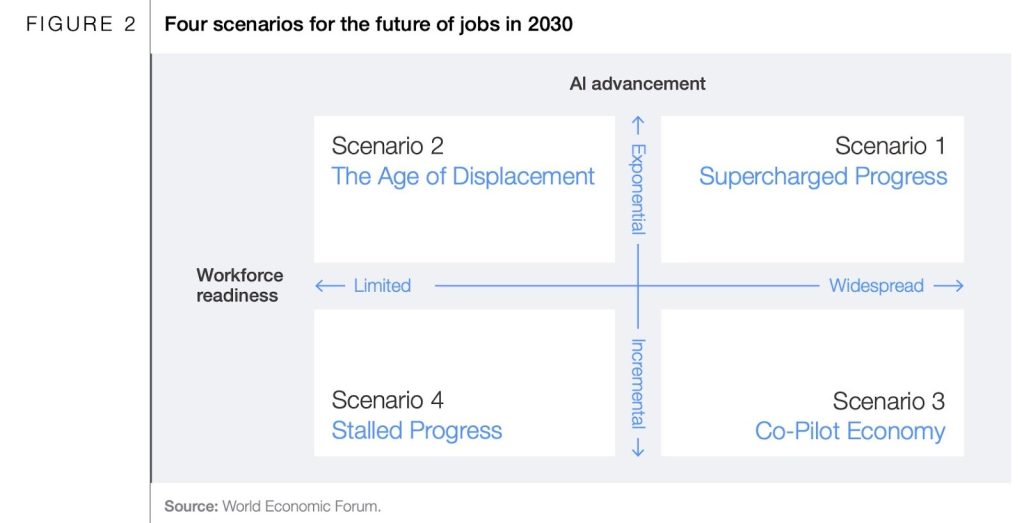
Source: World Economic Forum (2026), Four Futures for Jobs in the New Economy: AI and Talent in 2030
Todays AI breakthrough could lead to either mass flourishing or mass unemployment by 2030. So which will it be?
The World Economic Forum’s January 2026 report lays out four dramatically different futures for work, each shaped by two variables: the pace of AI advancement and workforce readiness.
In the “Supercharged Progress” scenario, workers become “agent orchestrators,” directing portfolios of AI systems while new occupations emerge at unprecedented speed. Flip that same exponential AI advancement against an unprepared workforce, and you get the “Age of Displacement”: unemployment spikes, consumer confidence collapses, and societies fracture under disruption faster than education systems can respond.
Hints of these diverging futures is developing right now in hiring decisions, strategic planning, and the widening divide between prepared and unprepared organizations.
The Market Is Already Shifting
Look at what OpenAI is hiring for: Their latest research engineer positions seek professionals who can “quantify the nuances of human behavior,” “design robust evaluations for measuring alignment,” and “develop mechanisms and interfaces that enable humans to both express their intent and to effectively supervise and control AIs.”
These are human problems requiring judgment, collaboration, and trust-building. The technology exists. What’s scarce are people who can bridge AI capability and human need, automation and augmentation, efficiency and ethics.
The WEF report shows 54% of business executives expect AI to displace existing jobs, while only 24% believe it will create new ones. Workforce readiness determines which prediction becomes reality.
What Readiness Really Means
The skill gap isn’t about mastering tools anymore. It’s about becoming the conductor who knows when and how to deploy them.
“We really try to emphasize the human being in all that we do,” says Dr. Lara Bradshaw, who teaches AI short courses at UW’s Communication Leadership program. “By that I mean the human having agency in the work and skills they develop.”
Real readiness means understanding AI within what Bradshaw calls “an AI and media literacy framework.” It means developing the discernment to know how, when, where, and why to use these technologies. It means asking hard questions about environmental impact when AI capital expenditure is projected to surpass $1.3 trillion by 2030 (aka more massive data centers sucking up energy, land and water). It means advocating for worker dignity even as productivity soars. It means building governance frameworks that can keep pace with the technology.
The WEF report’s “no-regret strategies” for businesses make this clear: “strengthen organizational culture and trust in emerging technologies,” “align technology and talent strategies,” “invest in human-AI collaboration.”
These are leadership imperatives requiring the exact skills communication professionals already possess.

Why Communication Leaders Are Uniquely Positioned
The skills needed to become “agent orchestrators” are already core to communication work: understanding audiences, building trust across diverse stakeholders, facilitating collaboration, and translating complex technical capabilities into strategies that serve human needs.
Communication Leadership at UW has built its curriculum around this intersection, weaving AI literacy with foundational skills in ethics, strategy, and storytelling to shape how students approach these powerful tools.
The program offers AI-focused courses covering topics from agentic design and conversational AI prototypes, to AI-enhanced market research and organizational communications.
But these technical skills are grounded in core classes that develop the judgment AI requires. Communicating Trust and Credibility for Emerging Technologies teaches students to advocate for AI honestly, while recognizing the fine line between storytelling and propaganda. The Law & Ethics of Community Building uses racial equity frameworks and behavioral ethics to help students identify when technology serves communities versus when it creates harm. Scenario Planning trains students to navigate uncertainty by developing multiple futures — exactly the mindset needed when AI’s trajectory remains unpredictable.
“We situate our AI work within an AI and media literacy framework,” Bradshaw explains. “This means we encourage students and professionals to think critically about AI as a technology and how it operates in our world. It’s really important that students and professionals develop discernment skills regarding AI technologies and establish guardrails and guidelines for how, when, where, and why they use the technology.”
For working professionals who want to build these skills without committing to a full graduate program, the Empowering Marketing & Communications with AI course offers a focused seven-week online experience. Taught by Dr Bradshaw, and brand strategist Sam Tang, the course covers AI storytelling, creative campaigns, and data analysis, all grounded in responsible AI principles.
“Having this ability and skill set to be discerning with these newer technologies very much contributes to workforce readiness,” Bradshaw notes.
The Stakes Are Clear
The WEF report shows us four possible futures. In “Supercharged Progress” and “Co-Pilot Economy,” workforce readiness enables human flourishing alongside AI advancement. Workers adapt, new occupations emerge, and human-AI collaboration reshapes value chains productively.
In “Age of Displacement” and “Stalled Progress,” lack of readiness leads to unemployment spikes, eroding competitiveness, widening inequality, and broken prosperity promises.
The technology will advance regardless. The variable we can control is how prepared we are to lead it ethically, strategically, and in ways that center human agency and well-being. That preparation requires intentional investment in education that goes beyond tool training to develop judgment, ethical frameworks, and the strategic thinking needed to navigate complexity.
The algorithms are ready. The question is, are we ready to lead them, or are we just waiting to see what happens next?

 University of Washington
 Department of Communication