Cohort 13, Master of Communication in Digital Media
Founder, Audiotocracy
Shannon Perry on Linkedin
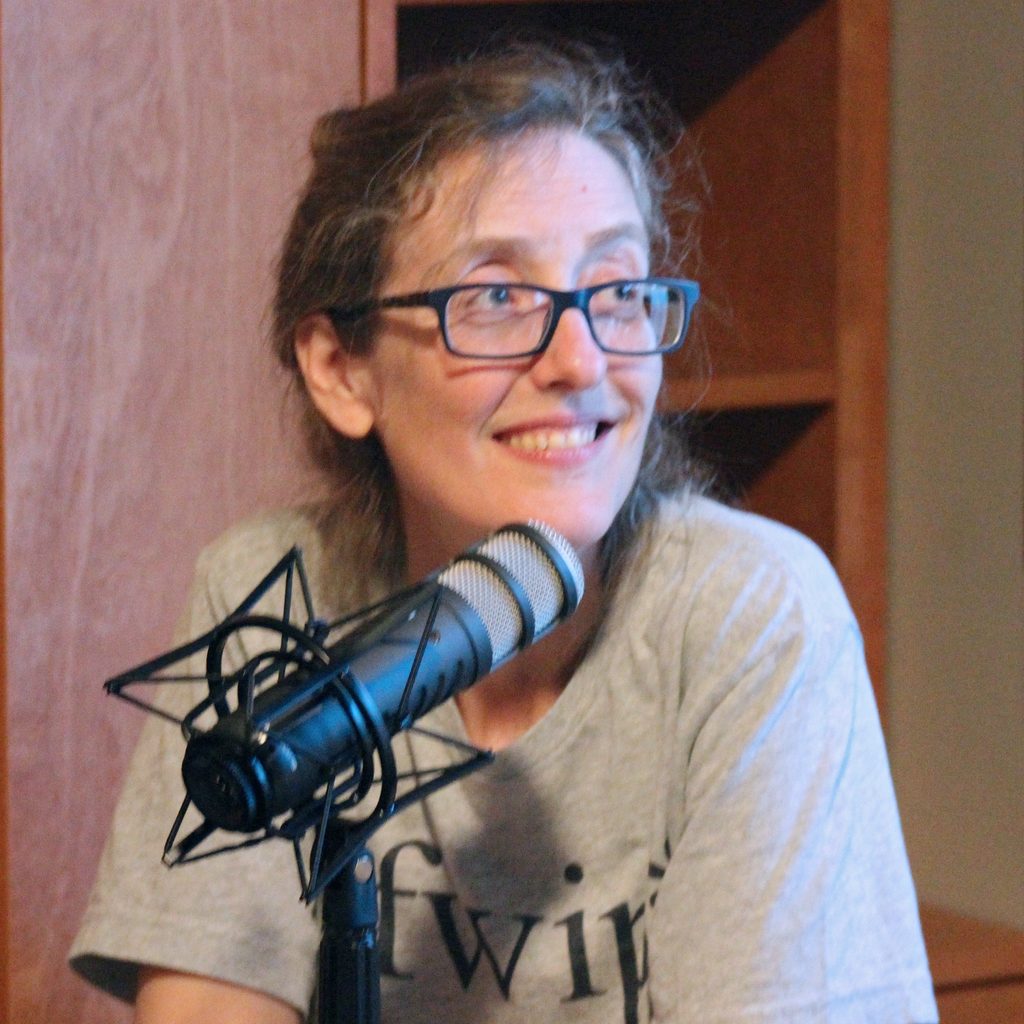
To start, if I approached you at a mixer and asked what you were up to and enjoying these days personally and professionally, how would you answer?
I’d likely promptly spill my drink on you, but after that….
I’m finding myself focusing my attention on gaining clients I truly want to work with, rather than feeling like I need to take whatever work comes my way. Now a few years into this whole entrepreneur gig, I’m really learning what stories excite me and what ones I’m happy to recommend to another producer. Sustainability and women’s topics (which are inextricably linked, I think) are two areas that I find so important and I’m enjoying looking for ways to help those topics get more reach and attention. It’s a work in progress! Equally, moving into the final season of my audio drama, I’m both enjoying pulling some threads together in that story and also looking ahead to new creative projects. It’s all about teams and working with others now!
The Fall 2026 alumni newsletter theme is storytelling in all its various forms, a topic near and dear to Comm Lead. What is your professional relationship to storytelling and how and when did you become involved in the craft?
It can be tricky explaining to business people with a very corporate — and in the case of many of our clients, a very medical- and science-based — approach that storytelling is appropriate and even necessary for their podcast. (Frankly, the word “storytelling” does us no favors, so I find myself resorting to “narrative.”)
Generally, convincing folks is simple: who doesn’t feel more engaged when facts come in story form? Teaching clients to lead with story, to ask questions that generate stories can be harder. Podcasting comes with its own challenges in that clients can’t rely on visuals to help “show.”
I’ve been a reader and writer of fiction pretty much all my life, and creating my own audio drama has been invaluable in teaching me how to tell stories through sound. A lot of that translates nicely to storytelling for non-fiction. I ask clients to think about the tools they use everyday and describe them for me. We have them sit in their environment and listen to the sounds and talk about what they’re hearing. It’s really about being open to the opportunity to elicit a story and, as Jessica Abel writes about, paying attention to what you pay attention to. When a guest says something that sparks in your brain, or when you see them sit up a little straighter, lean forward a bit more, follow that rabbit!
Can you share a bit more about your current work in audio storytelling, perhaps by sharing a project you’ve been working on lately that you’re particularly excited about?
One thing I’ve been involved with lately that’s really interesting is helping writers take their film and TV scripts and rework them for audio. It’s a fascinating process of discovering just how much storytelling happens on a subconscious level. I recently took a group of screen writers through an exercise of “the sounds of a person getting up in the middle of the night to pee.” It was great fun to see them realize how much information they can communicate without having to resort to a bunch of awkward exposition or narration.
Introducing others to the power of audio is really important. A lot of people are poo pooing it now, because TikTok, YouTube, Instagram, etc. seem to be pulling us back to video-first. But to me, these are different beasts. Captions, graphics, animations are all great, but nothing will ever mean as much to us as the snap of a branch in a dark forest.
To aspiring storytellers, what are some evergreen elements of memorable storytelling that you espouse?
Humans are humans. How’s that for reductionist? By that I mean, I think we’re learning that no matter the tech advances in communications platforms, we always resort to the same ways of communicating — through story. It might be an AI telling it, it might be some dude in his car, it might be slick and highly produced or via a cheap mic attached to a spatula, the preference for story never changes.
I think the most important lesson I try to keep in mind is that storytelling needs to involve all the senses, even if audio is the format. I still think about telling the story of race horses eating peppermint candies before a race – the crinkle of wrappers, the crunch and slobber from the horses, the odd mix of peppermint, hay, and horseshit in the air. There’s no equal to storytelling that hits on every level. But it’s easy to be so focused on the business at hand and miss the opportunities to land a really good, fully-fleshed-out story.
Finally, we always like to ask: what’s a favorite piece of content—anything goes!—you’ve been hooked on lately you think Comm Lead alumni might enjoy?
I listen to a metric crapton (yes, that is a standard measure) of audio fiction. There is some spectacular creativity and storytelling happening, and some of them are a master class in “showing over telling” in a purely audio medium. There is something for every taste, there is representation on a level no other medium has truly reached. I am particularly likely to wander over to the science fiction podcasts, partly because my own falls into that category (rather like a small child stuffs a puzzle piece into a space that isn’t quite right, but it’ll do) but also because science fiction has always been a step or 10 ahead of science non-fiction. Even more because scifi offers a window on how people feel about and might react to technological “advances.”
Some I highly recommend are Oblivity, Relativity, We Fix Space Junk, Curious Matter Anthology, Girl in Space, and Midnight Burger. Enjoy!

 University of Washington
 Department of Communication